
How Songwriting Builds Confidence in Primary School Children — A Cornerstone Guide (September 2026)

Introduction: Confidence Is Built, Not Born
Confidence isn't something children simply have or don't have — it's something they build through positive experiences. Every time a child discovers a new skill, overcomes a challenge, or realises that their ideas matter, their confidence grows a little stronger.
For more than fifteen years, I've had the privilege of working with thousands of children in primary schools across the UK through The Songwriting Charity. One of the most rewarding parts of my job is seeing children who arrive quietly at the back of the classroom leave proudly performing a song they helped to create.
This guide is for teachers, school leaders, and anyone who cares about children's wellbeing and creative development. It draws on fifteen years of workshop delivery, real teacher testimonials, and a growing body of research that confirms what we see every single day: songwriting builds confidence in children in a way that is immediate, inclusive, and lasting.
Why Songwriting? The Evidence Behind the Practice
Before we get into the classroom, it's worth grounding this in evidence — because the case for creative arts in education is stronger than many people realise.
Research by Durham University's Centre for Evaluation and Monitoring, published as part of the Artsmark evaluation, found that sustained engagement in arts education is associated with measurable improvements in pupil confidence, communication, and social skills. Schools with strong arts provision consistently report higher levels of pupil engagement and lower rates of exclusion.
A landmark study by the Cultural Learning Alliance — drawing on data from over 6,000 young people — found that children who engage regularly in arts activities are three times more likely to win an award for school attendance, four times more likely to participate in community service, and significantly more likely to report high levels of self-confidence.
Closer to home, our own independent programme evaluation at The Songwriting Charity recorded a 23.2% measurable shift in confidence among participants following a single workshop. Our work with more than 25,000 children over 15 years has consistently shown that collaborative songwriting can help children develop confidence, resilience and a stronger sense of belonging. Over 90% report an improvement in confidence. These are not soft, anecdotal outcomes. They are consistent, replicable, and meaningful.
The research and our own evidence point in the same direction: songwriting builds confidence in children — and it does so consistently, across ability levels, backgrounds, and settings.
Every Child Has Something Worth Saying
Many children arrive at a songwriting workshop believing they aren't musical or can't write songs. Within minutes, those beliefs begin to change.
Songwriting isn't about finding the next pop star. It's about helping children discover that their ideas, experiences, and emotions have value. A single word, a rhythm, a melody, or even a conversation can become part of a song. Every contribution matters, and every child sees that they have something unique to offer.
What This Looks Like in the Classroom
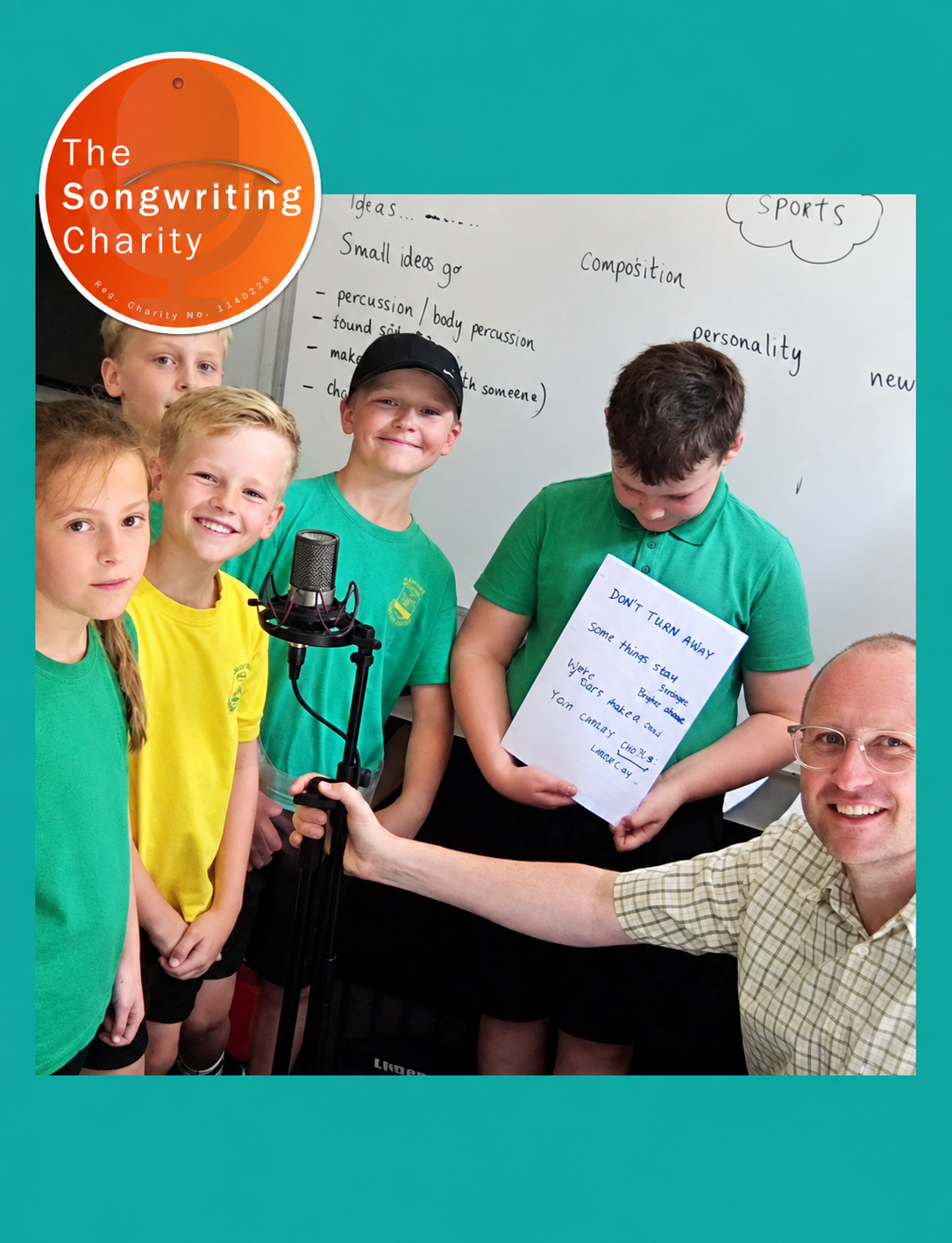
I remember a Year 5 boy who sat with his arms folded at the start of a Bully Beat workshop in South East London. He'd been told by a previous teacher that he wasn't creative. For the first twenty minutes, he said nothing. Then, during a group brainstorm about what it feels like to be left out, he quietly offered a single phrase: like you're invisible. The room went still. His classmates loved it. That phrase became the hook of their song. By the end of the day, he was standing at the front of the class, singing his own line into a microphone, grinning from ear to ear.
That moment — that shift from I can't to I did — is what songwriting does. And it happens in almost every workshop we deliver.
There Are No Wrong Ideas
Unlike many classroom activities where answers can be right or wrong, songwriting encourages creativity without judgement. Children quickly realise that there isn't one perfect lyric or melody. Instead, they learn to listen, experiment, and improve ideas together.
This creates a safe environment where pupils become more willing to speak up, take creative risks, and support one another. For children who have learned to stay quiet — whether through fear of failure, past criticism, or simply not feeling seen — this can be genuinely transformative.
Faye Blain, a teacher at Sherington Primary School, put it better than I ever could:
Possibly one of the best visiting workshops that I have participated in in over 10 years of teaching. Pupils were open in discussing experiences and were able to show a better understanding of what bullying is. Well planned, fantastic delivery and a great connection with the pupils.
That openness — pupils willing to share real experiences and feelings — doesn't happen by accident. It happens because songwriting creates a space where there are no wrong answers, only contributions.
Success Comes Quickly — and It's Real
One of the most exciting moments in our workshops is when a class hears their song played back for the first time. Only a short while earlier, it didn't exist. Now it's their music. Their lyrics. Their voices.
That sense of achievement is incredibly powerful because children experience success in a very real and immediate way. There's no waiting for a test result or a teacher's mark. The song is finished. It's theirs. And it's brilliant.
A Moment of Breakthrough
In a Songs That Speak workshop at a primary school in Dartford, a girl in Year 4 — quiet, often anxious, rarely the first to volunteer — had been working on a verse about friendship. When the class performed the finished song together and she heard her own words sung back by the whole group, she burst into tears. Not sad tears. The kind that come when something you made turns out to be more beautiful than you expected.
Her class teacher told me afterwards that she'd never seen that child stand so tall.
Those moments don't just feel good in the room. They become part of how children see themselves — and that matters long after the workshop is over.
Every Voice Is Included
Not every child enjoys standing at the front of the class. Songwriting naturally creates different roles for different personalities. Some children enjoy singing. Others write lyrics. Some suggest ideas. Others help shape melodies or encourage their friends. Everyone contributes, and everyone becomes part of the finished piece.
This is especially valuable for children who sometimes struggle to find their place in more traditional classroom activities — including children with SEND, those with communication difficulties, and those who are simply quieter by nature.
Diane Mullins, Head of Year at Eltham Hill Secondary School, observed something that resonates deeply with what we see in primary settings too:
Girls who were seen to be not cool or respected by other girls now seem to have more street cred and appear more confident.
Social dynamics shift when every child has a genuine role. The child who never speaks up in literacy becomes the one who wrote the best line. The child who struggles with reading becomes the one with the strongest melody idea. Songwriting redistributes status — and that redistribution can be quietly life-changing.
Amy Vinnicombe, a school teacher who has worked with The Songwriting Charity for over thirteen years, describes her very first workshop:
It was a transformative day — the children flourished and blew me away with their creativity, confidence and enthusiasm! I cried at how special the experience was. It was the start of a wonderful relationship between our school and the charity.
Building Communication Skills That Last
Writing songs encourages children to:
Express emotions in words and music
Explain ideas clearly to their peers
Listen carefully and build on others' contributions
Compromise and negotiate creatively
Solve problems as a team
Perform with confidence in front of an audience
These are life skills that extend far beyond music lessons. Teachers consistently tell us that the communication and teamwork skills children develop in a songwriting workshop show up in other areas of school life — in group projects, in PSHE discussions, in how children talk to one another on the playground.
Del Rowland, a teacher at Alex McLeod Primary, noted:
It is an excellent way of bringing your class together and has good links with their real life in school and citizenship and social awareness.
That connection to real life is central to what makes songwriting work. It isn't an add-on. It's curriculum-relevant, emotionally intelligent, and deeply practical.
Confidence That Lasts Beyond the Workshop
One of the most rewarding things teachers tell us is that children often continue talking about the workshop weeks or even months later. They remember: I wrote that line. That was my idea. I sang on that recording.
Those memories become part of how children see themselves. Instead of thinking, I'm not very creative, they begin to think, I can do this. That shift in self-belief can have a lasting impact — on how they approach challenges, how they relate to their peers, and how they feel about school.
Nav Sanghara at Rockliffe Manor Primary School described the experience simply and warmly:
Fantastically well led, exciting and informative for the children.
Simple words. But they reflect something important: when a workshop is well-delivered and genuinely engaging, children don't just learn — they remember. And what they remember shapes who they become.
Supporting Emotional Wellbeing
Songwriting also gives children a safe way to explore feelings they may struggle to express in everyday conversation. Whether writing about kindness, friendship, resilience, change, or hope, music provides an outlet for emotional expression while encouraging empathy and understanding.
Many schools tell us that songwriting complements their wider wellbeing, PSHE, and anti-bullying work because it allows important conversations to happen naturally. Children who might shut down in a circle time discussion will open up when the same topic is approached through a song.
Our Bully Beat programme — which uses songwriting specifically to address bullying, emotional resilience, and peer relationships — has produced a 40% reduction in revenge bullying in participating schools. That's not just a creative outcome. That's a safeguarding outcome. And it happens because children who feel heard are less likely to lash out.
A Class Performing Their Song
At the end of every Bully Beat workshop, the class performs their finished song — sometimes to each other, sometimes to the whole school. I've watched hundreds of these performances. What strikes me every time is not the quality of the singing (though it's often remarkable). It's the look on the children's faces. Pride. Ownership. Joy.
One Year 6 class in Kent performed their anti-bullying song in a whole-school assembly. The headteacher told me afterwards that several children who had been involved in bullying incidents earlier that term were among the most engaged performers. Something had shifted. They had found a better way to be seen.
That is what songwriting does at its best.
Why Schools Trust That Songwriting Builds Confidence in Children
Schools often tell us they value songwriting because it:
Builds confidence and self-esteem in every child
Develops teamwork and communication skills
Encourages creativity and risk-taking
Supports emotional wellbeing and PSHE objectives
Gives every child a voice - including those who struggle in traditional settings
Creates a lasting memory through a professionally recorded song
Complements anti-bullying, SEND, and inclusion strategies
Delivers measurable, evidenced outcomes
Most importantly, children leave believing in themselves a little more than when they arrived. And that's something every child deserves. That is the simplest and most powerful reason why songwriting builds confidence in children - and why schools keep coming back.
Confidence doesn't begin when children discover they can sing. It begins when they discover that their ideas matter.
If you're interested in the wider wellbeing benefits, read our article on How Songwriting Helps Children's Mental Health and Self-Esteem.
Frequently Asked Questions
How does songwriting improve confidence in children?
Songwriting gives children a creative space where there are no wrong answers. Every idea is valued, every contribution matters, and the finished song is proof that they made something real. That combination of inclusion, creative ownership, and visible achievement builds confidence in a way that is immediate and lasting.
Is songwriting suitable for children with no musical experience?
Absolutely. Our workshops are designed for children with no prior musical experience whatsoever. You don't need to be able to sing, play an instrument, or read music. If you have ideas, feelings, and words — and every child does — you can write a song. Our facilitators are skilled at drawing out contributions from every child in the room.
Can songwriting support children's mental wellbeing?
Yes — and the evidence is strong. Songwriting helps children express emotions they may struggle to articulate in conversation, process difficult experiences through creative metaphor, and build a sense of identity and self-worth. Our own programme data shows a 23.2% measurable shift in confidence following a single workshop, and our Bully Beat programme has produced a 40% reduction in revenge bullying in participating schools.
How long does a school songwriting workshop last?
Most of our school workshops run for a full day (approximately 9am to 3pm), though we also offer half-day sessions and multi-day residencies. A full-day workshop gives children enough time to develop ideas, write lyrics, shape a melody, rehearse, and perform their finished song — which is the moment that makes it all real.
Does songwriting fit into the curriculum?
Yes. Our workshops link naturally to the National Curriculum across several subjects: Music (composition, performance, listening), English (writing, vocabulary, spoken language), PSHE (emotional wellbeing, relationships, anti-bullying), and SMSC (spiritual, moral, social, and cultural development). Many schools use our workshops as a curriculum enrichment day or as part of a themed week.
What happens if some children are reluctant to participate?
This is one of the most common questions we hear — and one of the most rewarding to answer. In our experience, reluctance almost always gives way to engagement once children realise there are no wrong answers and no pressure to perform. We create roles for every personality: writers, idea-generators, melody-shapers, performers, encouragers. The child who arrives with arms folded is often the one who surprises everyone by the end of the day.
How do we know the workshop will have a lasting impact?
Beyond our own programme data, the research is clear: arts-based interventions that are well-structured, facilitated by skilled practitioners, and connected to children's real experiences produce lasting outcomes. Teachers consistently tell us that children talk about their workshop weeks and months later — and that the confidence they built in the room shows up in other areas of school life. We also provide schools with a professionally recorded version of the song the children created, so the memory lives on.
About Nathan Timothy
Nathan Timothy is a UK songwriter, producer, and founder of The Songwriting Charity — an organisation that has helped more than 25,000 children and young people develop confidence, creativity, and emotional wellbeing through songwriting workshops in schools across the UK.
Nathan started Bully Beat in 2005, drawing on his background as a primary school creative arts specialist. Through projects including Bully Beat, Sports Tracks, Something Kind, Songs That Speak, Project K, Connections and School Anthem Programmes, he works with primary schools, secondary schools, and SEND settings to help young people discover the power of music and their own creative voice.

Comments