
How Songwriting Helps Children's Mental Health and Self-Esteem

What if one of the most powerful tools for children's mental health wasn't a clinical intervention, but a song?
Every day, children across the UK carry emotions they don't have the words for. Anxiety, loneliness, low self-worth, the aftermath of bullying - these experiences are real, they are rising, and they deserve a real response. At The Songwriting Charity, we believe that giving a child the chance to write their own song isn't just a creative activity. It's an act of empowerment. It says: your voice matters. Your story is worth telling.
This post explores the evidence behind songwriting as a tool for children's mental health and self-esteem and why more schools, families, and commissioners should be turning to creative approaches to support young people's wellbeing.
The Mental Health Crisis Facing Young People
The scale of the challenge is significant. According to NHS England, one in five children aged 8–16 now has a probable mental health disorder and that's a figure that has risen sharply since 2017. Anxiety, depression, and low self-esteem are among the most commonly reported issues, and the demand for CAMHS support continues to outstrip supply.
For many children - particularly those in disadvantaged communities, those with SEND, or those who have experienced trauma - traditional talking therapies can feel inaccessible or intimidating. Schools are under pressure to support wellbeing within the curriculum, often with limited specialist resources.
Creative approaches that meet children where they are - in the classroom, in the community, in their own language have never been more needed.
How Songwriting Works as an Emotional Tool
Songwriting is uniquely powerful because it combines three things that are essential to emotional health: expression, processing, and identity.
Expression - Many children, especially those who struggle with literacy or verbal communication, find it easier to express difficult feelings through music and metaphor. A lyric can say what a conversation cannot. The act of putting words to a melody creates distance from raw emotion, making it safer to explore.
Processing - Writing a song about an experience — whether it's feeling left out, dealing with change, or navigating conflict — helps children make sense of what has happened to them. It externalises the internal. Research in music therapy consistently shows that creative expression supports emotional regulation and reduces anxiety.
Identity - Perhaps most importantly, songwriting builds a sense of self. When a child hears their own words performed back to them as a finished song, something shifts. They see themselves as capable, creative, and worthy of being heard. That shift in self-perception is the foundation of lasting self-esteem.
Unlike passive music consumption, songwriting is active. Children are not just listening - they are authoring. And authorship is inherently empowering.
What the Research and Our Evidence Shows
The Songwriting Charity has worked with over 25,000 young people across 15 years of delivery. Our data tells a consistent story.
90%+ of participants report an improvement in confidence following a songwriting workshop
Independent evaluation of our programmes recorded a 23.2% measurable shift in confidence among participants
Our Stem Hub programme - delivering remote music mentoring in Kent and Medway - has demonstrated sustained wellbeing benefits for young people accessing support for mental health challenges
Our Bully Beat anti-bullying songwriting programme has produced a 40% reduction in instances of bullying in participating schools, alongside measurable improvements in empathy and peer relationships
These are not soft outcomes. They are evidence of a structured, replicable intervention that works - across primary and secondary settings, across ability levels, and across some of the most complex and underserved communities in the country.
Real Stories
Numbers matter. But so do voices.
Cathryn Andrews, former Headteacher at Kemsley Primary Academy and now Development Director for The Crofty Education Trust, has seen the impact of our workshops first-hand across multiple years of partnership:
"Without doubt, the one-day workshops carried out by the Songwriting Charity have had some of the most powerful and long-lasting impacts upon our pupil population... Children that find literacy and classroom environments challenging flourish in the creative environment that the songwriting workshops create."
She describes how the Bully Beat workshops in particular help children to "focus their thoughts on the emotional and physical effects of bullying" and "trust in their peers to share innermost thoughts and fears" - adding that "it is not necessarily those that are academically more able that shine. Children who have never volunteered themselves before as leaders of a situation shone as they took on lead vocals."
At Wentworth Primary School in Dartford, teacher Veronica Forcella-Burton noted how the workshop "helped build confidence" and left children "feeling incredibly proud" of what they had created together.
Grant Roe at The Brent Primary School observed that the sessions "helped less-confident children, including pupils with SEN, get involved in ways they felt comfortable with" — a reminder that songwriting is not just for the naturally expressive. It creates space for every child.
These stories are not exceptional. They are typical.
Who Can Benefit?
Songwriting workshops are not a one-size-fits-all programme — and that's precisely their strength. Our work reaches:
Primary school children (KS1–KS2) exploring emotions, friendships, and identity through creative play and collaborative writing
Secondary school students (KS3–KS4) processing more complex experiences — peer pressure, mental health, belonging, aspiration
Children with SEND - including those with autism, ADHD, communication difficulties, and learning disabilities - who often thrive in the non-hierarchical, sensory-rich environment of a songwriting session
Pupils in Pupil Referral Units (PRUs) and alternative provision, where traditional academic engagement has broken down but creative connection remains possible
Children in community settings - youth clubs, family hubs, community centres — particularly in areas of high deprivation
Young people supported by NHS CAMHS (Child and Adolescent Mental Health Services) or Early Help services, where songwriting can complement therapeutic work as a low-barrier, high-engagement creative intervention
Wherever children are — and whatever challenges they face — songwriting can meet them there.
How to Get Involved
Whether you're a teacher, a parent, a school leader, or a commissioner, there are several ways to bring the power of songwriting to the children in your community.
Schools can book a one-day Songs That Speak workshop, a Bully Beat anti-bullying programme, or a bespoke residency tailored to your school's priorities. Our workshops are curriculum-linked, fully facilitated, and designed to leave a lasting legacy — a finished song the children can be proud of.
Community organisations and NHS partners can explore our Stem Hub mentoring programme or commission a bespoke wellbeing series for the young people you support.
Parents and carers can find out more about our programmes and advocate for songwriting in your child's school — or get in touch to explore how we can support your family directly.
Funders and commissioners can partner with us to scale our impact. We are actively seeking partners to expand our reach into new schools, new regions, and new communities.
Visit songwritingcharity.org to find out more, or get in touch directly to discuss how we can work together.
In summary
Children don't need to be musicians to benefit from songwriting. They just need to be heard.
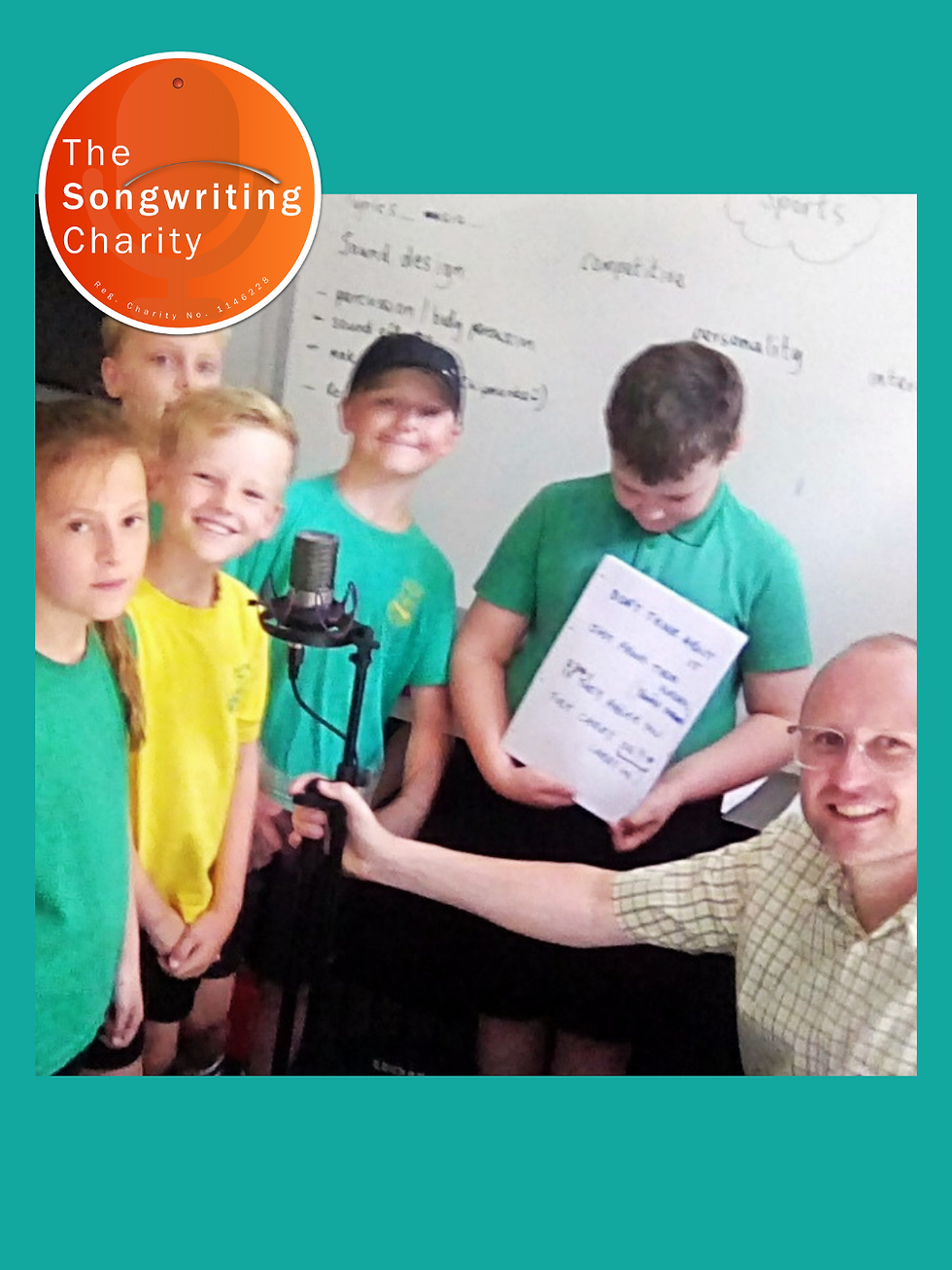
At The Songwriting Charity, we have spent 15 years proving that when you give a child a microphone - metaphorically and literally - something remarkable happens. Confidence grows. Connections form. Difficult emotions find a safe place to land. And a young person who may have felt invisible discovers that their voice has power.
The mental health of our children is one of the defining challenges of our time. Songwriting won't solve it alone. But it is one of the most human, joyful, and evidence-backed tools we have and we believe every child deserves access to it, regardless of where they live or what they can afford.
That's why we exist. And that's why this work matters.
What shall I write a song about today? Don't disturb me I'm concentrating! Deep in discusion I love this bit! I'm so proud of myself Working together as a team
The Songwriting Charity is a registered UK charity (No. 1146228) delivering award-winning songwriting programmes in schools, communities, and specialist settings across the UK. To find out more or book a workshop, visit songwritingcharity.org.
Comments